

Midac Batteries

EU BATTERY REGULATION

EU BATTERY REGULATION

EU Battery Regulation

Today, June 5, marks the World Environment Day.
On the occasion of this anniversary, we take stock of the latest legislative developments in the EU Battery Regulation.
Objectives of the Regulation according to Article 2: “The objectives of this Regulation are to contribute to the efficient functioning of the internal market, while preventing and reducing the adverse impacts of batteries on the environment, and to protect the environment and human health by preventing and reducing the adverse impacts of the generation and management of waste batteries.”
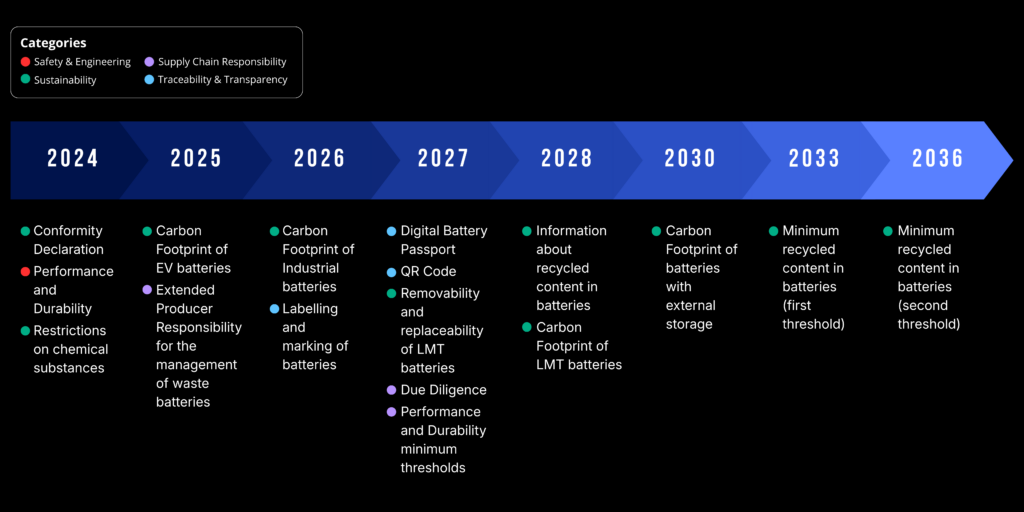

Timeline points

2024

Conformity Declaration
Drafting of the EU declaration of conformity, certifying compliance with the safety and sustainability requirements of the Regulation.
 
Performance & Durability
Obligation to provide technical documentation containing electrochemical performance and durability values (capacity, internal resistance, efficiency).
 
Restrictions on chemical substances
Strict restrictions and limits on the use of hazardous chemical substances (e.g., mercury, cadmium, and lead) in batteries to protect health and the environment.

2025

Carbon Footprint of EV batteries
Entry into force of the mandatory carbon footprint declaration for electric vehicle (EV) batteries.
 
Extended Producer Responsibility for the management of waste batteries
Introduction of the Extended Producer Responsibility (EPR) to finance and organize the collection, treatment, and recycling of waste batteries.

2026

Carbon Footprint of Industrial batteries
Mandatory carbon footprint (CFP) declaration for industrial batteries with a capacity above 2 kWh.
 
Marking and labelling of batteries
Mandatory application of visible labels containing general battery information and the separate collection symbol.

2027

Digital Battery Passport
Introduction of the Digital Product Passport (DPP) to track traceability, sustainability, and life cycle of industrial batteries.
 
QR Code
Mandatory printing of a QR code on the battery for quick access to regulatory information and recycling data.
 
Removability and replaceability of LMT batteries
Obligation to design light means of transport (LMT) so that batteries are easily removable and replaceable by the user or professionals.
 
Due Diligence
Obligation for economic operators placing batteries on the market to comply with due diligence policies regarding the raw material supply chain.
 
Performance and Durability minimum thresholds
Application of the established minimum electrochemical performance and durability thresholds for industrial batteries.

2028

Information about recycled content in batteries
Obligation to accompany the battery with documentation indicating the percentage of cobalt, lithium, nickel, and lead recovered from recycling.
 
Carbon Footprint of LMT batteries
Publication of the carbon footprint performance classes for light means of transport (LMT) batteries.

2030

Carbon Footprint of batteries with external storage
Mandatory carbon footprint declaration and definition of performance classes for battery energy storage systems (BESS).

2033

Minimum recycled content in batteries (first threshold)
First mandatory threshold for minimum recycled content in active materials: Cobalt 16%, Lead 85%, Lithium 6%, Nickel 6%.

2036

Minimum recycled content in batteries (second threshold)
Increase of the mandatory minimum recycled content targets: Cobalt 26%, Lead 85%, Lithium 12%, Nickel 15%.

Conclusions

Many delegated acts are still to be published by the EU, but the roadmap to batteries sustainability has already been laid.
In the meantime, we’re constantly monitoring the latest publications and we’re already working to anticipate the change by adapting our internal processes.
#EUBatteryRegulation

2560 1280 Midac Batteries
Close